Monday, June 6, 2016

Ramadan - A Chance to Unite in Diversity


بسم الله الرحمن الرحيم
شهر رمضان الذي أنزل فيه القرآن هدى للناس وبينات من الهدى والفرقان
Dear Brothers and Sisters in Faith
As-Salaamu ‘Alaikum (Peace and Blessings be Upon You)

Indeed all Praise is due to Allah, our Fashioner and Creator.  We Praise Him and we seek His Forgiveness.  Whomever Allah guides, none can misguide and whomever Allah leaves astray, none can guide aright.  May Peace and Blessings be upon His Final, Most Noble Messenger, Mohamed (Peace Be Upon Him- PBUH), his family, his companions and the true believers throughout the ages.

As the month of Ramadan is just around the corner, I would like to congratulate you on this Holy Month.

All of us are on a journey.  Though our methods of transportation maybe different, we are all travellers on the same path towards spiritual enlightenment and happiness. 

The ultimate and most difficult lesson to learn on this journey is to understand our destination. For those of you who have read The Alchemist by Paulo Coelho, the understanding of this destination is very simple: ‘Go; travel the world, look for the truth and the secret of life – every road will lead you to this sense of initiation: the secret is hidden in the place from which you set out’.  Thus you find God only by rediscovering the essence of your own nature. The essence of your own nature is the ‘return to oneself’ with a consciousness of the other.
This is the apparent paradox of spiritual experience whereby the constant effort that we make to purify, to control and liberate our hearts is in the end, reconciliation with the deepest level of our being.  That spark that the Creator breathed into our heart (the fitra) is the spark of humility, the awareness of fragility, the consciousness of limitation, the shoulder of responsibility.
To develop this state is the very essence of Ramadan, something that is often missed in the superficial celebrations of this most blessed month. At the heart of our consumer society, where materialism and individualism drive our daily lives, this Blessed Month of Ramadan reinforces our personal effort and commitment, invites us towards the deep horizons of introspection and meaning, reminds us of silence, restraint and remembrance, and inculcates the importance of detail, precision, rigour and discipline of practice.  It is one we expect with relish.
Two months before Ramadan, i.e., in the month of Rajab, the Prophet, peace and blessings of Allah be upon him, used to pray to Allah to make him witness the month of Ramadan. He used to say: “O Allah, bestow Your blessings on us during the months of Rajab and Sha`ban, and make us witness Ramadan.” The Prophet said that out of his deep love and appreciation for the rank of the holy month of Ramadan in the Sight of Allah.
The question that is often asked is what is the significance of Ramadhan?  By answering this question, we might understand its importance for the Muslims.
A poet says about the merit of Ramadan: “Ramadan is the farm where soul-purifying seeds are sown. So water such seeds by good deeds. Bad deeds will cause you loss.’’
Ramadan is a reminder of the essence of time: Ibn Abbas (RA) heard the Prophet (SAW) advising someone, saying, “Take advantage of five before five: You’re youth before your old age, your health before your sickness, your wealth before your poverty, your free time before you become occupied, and your life before your death.”
Al Fudayl ibn Iyaadh (RA) once sat with a senior and asked him, “How old are you?” The man replied, “60 years old.” “Did you know,” said Al Fudayl, “that for 60 years you have been traveling towards your Lord, and that you have almost arrived.” The man was reduced to silence. He whispered, “Inna lillahi wa Inna Ilayhi Raaji’oon (To Allah we belong and to Him we return).” Al Fudayl asked, “Do you know the meaning of that statement.

You are saying that you are Allah’s slave and that to Him you are returning. Whoever knows that he is the slave of Allah, and that to Him he shall return, should know that he shall be stopped on the Day of Judgment. And whoever knows that he will be stopped, let him also know that he will be responsible for what he did in life. And whoever knows that he will be responsible for what he did, let him know that he will be questioned. And whoever knows that he will be questioned, let him prepare an answer now!” “What then shall I do,” asked the man.
“It is simple,” said Al Fudayl. “Do good in what is left of your life, forgiven shall be your past. If not, you shall be taken to account for the past and what is to come.”
This is the essence of the concept of God Consciousness or Taqwa which is what Ramadan is supposed to reinforce.  It is about being aware of the choices to make.
 A wise man once said, ‘Between every stimulus and response there is a space.  In that space lies our freedom and power to choose our response.  In those choices lie our growth and happiness.’

Such is the meaning of profound spirituality requiring man to acquire a force of being and doing Hence within this space everyone is asked to take up a dialogue with The Most-High and The Most-Close, a dialogue of intimacy, of sincerity, of love.  Within this space is the horizon of all spirituality requiring man to acquire a force of being and doing, rather than to undergo despotic relentlessness of a life reduced to mere instinct.  Within this space, we marry the purpose of our existence with the purpose of our subsistence.   Close to the Quran’s light, its words and inspirations, we must comprehend the message: You are indeed what you do with yourself. You are responsible for the actions you take.

Hence you ask yourself, ‘Am I here by chance?’  The response you will get is ‘No, I am here for a purpose’.  That purpose is to serve humanity, those in need; those without! That purpose is to awaken our conscience in the proximity of the wounds and the injustices people face! That purpose is to move away from selfishness / greed and waste; to distance our selves from the darkest dimensions of our being, our violence, our jealousies, our superficialities.  That purpose is to face our responsibilities with confidence and assurance

Thus Ramadan reinforces our sense of purpose and responsibility whilst nurturing the inspiration from the Qur’an that ‘God will not change anything for the good if you change nothing’!!

The Blessed Month of Ramadan is not a feast of food as it is now commonly practised but a feast of the faith of fraternal atmosphere that is shared with all brothers and sisters. Unfortunately, over the last couple of years, the concept of a fraternal atmosphere has been denigrated to a single notion within the mindset of the Muslim community, who have gradually entrenched themselves into an ideological box.  This ideological comfort zone is an intellectual arrogance leading to an isolationist mentality and cultural ghetto, which world over, Muslim communities; especially those that live under minority situations, place themselves in.  This isolationist mentality imbibes an ‘us’ vs ‘them’ attitude and has meant that the Muslim community has always been worried about ‘us’ rather than taking an all encompassing ‘we’. 

This assumption of singularity is the weapon of sectarian activists who want people to ignore all affiliation and loyalties in support of one specific identity.  This is deeply delusive, divisive and is one that leads to social tension and violence for there is a sense of injustice and intolerance that is created from potential misunderstandings and misperceptions.

As the blessed month of Ramadan teaches us, we share the burdens of others (especially those less fortunate than us) and we remember our responsibilities towards them.  Identifying with others in different ways is important in our role of living in society.   Thus we should remember that we are much more than a label, that our plurality and diversity are not divisive elements but are a cause for celebration but within that celebration is an understanding of common humanity and universal principles.  This is the call for unity of the Muslim community and society as a whole that is made during this blessed time. 

This call for unity is founded upon a universal humanitarian principle based on the following verse from the Holy Qur’an “…If anyone saved a life, it would be as if he saved the life of all mankind…” (Q5:32).    

Thus responsibility is placed upon the shoulder of the individual to take the lead in becoming a true citizen of the country and of the world, where he / she rise above their narrow confines of individualistic concerns to face the broader concerns of all humanity and to redress the contradiction of society enabling people and their communities to live in dignity, peace and independence with social justice.

This contradiction of society will be redressed when all citizens come together confident in their universal principles; strengthened by their common values; they will be defenders of pluralism in their society and respectful of identities of others; they will take up the challenge of joining forces in a revolution of trust and confidence against the tide of discrimination and intolerance and poverty.
Ramadan should inculcate this feeling that there is a need to create a society where there is a feeling of brotherhood and love of one’s neighbours.  The Prophet (Peace Be Upon Him) said that ‘no one is a believer if you go to bed whilst your neighbour is hungry’.  Islamic scholars debate that feeding the hungry neighbour is equivalent to feeding the empty stomachs 40 doors to the right and left.

This is the Prophetic vision which demonstrates how we must work, together, with others, with our neighbours. So a world which makes sense, is a world in which we connect with other people, often beyond our immediate communities and experience, and show them compassion and love.  

The Prophet Mohammed (Peace Be Upon Him) said “You shall not enter Paradise until you have faith, and you cannot have faith until you love one another. Have compassion on those you can see, and He Whom you cannot see will have compassion on you Thus we learn  our purpose of existence to stand by justice and equity; to portray the humility and compassion of the Prophet (upon whom be peace) towards the downtrodden, the distressed and the oppressed regardless of who they are.

How can we make use of this month of Mercy? 
We can prepare for Ramadan by taking stock of ourselves and recognizing our shortcomings. Our acts of worship such as praying in congregation; remembering Allah (dhikr); paying attention to the rights of neighbors, relatives, and the Muslims; spreading the greeting of salam; enjoining good and forbidding evil; urging one another to follow the truth and be patient and steadfast in doing so all discipline us in this process.

Use Ramadan to reconcile disputes between families and friends as a sign of the remembrance of God. This Ramadan, strive to reinforce this remembrance of God and to remember our duties with the people, for to be with God is to be with the people.  This Ramadan inculcate our responsibility as creations of God to serve humanity.

This Ramadan re-learn the universal values of peace, compassion and justice as articulated by Islam, reinforced by Ramadan and binding in the brotherhood of humanity.  Develop a greater social policy that empowers people, recognizes their plurality and that searches for commonalities within this pluralism that will lead to greater respect and ultimately greater understanding.

May Allah accept our worship during His Holy Month, may He accept our prayers, supplications and sacrifices and save it for us on the final Day as deeds that will help us attain the most nobles of causes, the highest level of Paradise, Jannat-ul-Firdous.  Ameen


Ramadhan Mubarak!!!


Wednesday, May 25, 2016

The World Humanitarian Summit: Rethinking the Role of Faith in Humanitarian Action

From the 23-24th of May, Istanbul will see the first ever World Humanitarian Summit (WHS) convened by the UN Secretary General.  The summit is unique in the sense that it will see a space being created for a multi-stakeholder engagement between member states, INGOS, civil society, academics and private sector.  The process leading up to the WHS has also been an interesting process as 23,000 people in more than 150 countries globally have been consulted as to their expectations for a re-imagination of what humanitarian response should be and what the humanitarian architecture should look like.
One of the key aspects of the rethink that has been suggested is the need to localise aid response and to empower local communities to respond.  At the heart of any response to humanitarian disasters is the local community as they are the first responders. In this aspect, the role of religious institutions, leaders and faith based organisations (FBOs) becomes very important as they have a unique comparative advantage as ‘first’ responders: they have an established relationship of trust and familiarity with most local communities in which they are embedded.  They are also linked through family, worship, economic ties and joint heritage, across the globe. This makes strengthened engagement with such networks an appropriate element of strategies to enhance local and national capacity for crisis preparedness, mitigation and response whilst being sustained financially. It is also increasingly recognised that through belief and ritual, local faith communities may provide a sound base for bolstering community resilience in the immediate aftermath of crisis.
Despite this involvement, there has been a certain reluctance to recognise and acknowledge this role and subsequently engage with faith organisations on such measures. This reluctance stems from the fact that despite faith communities and FBOs being highly active, there is a character to the religious playing field that complicates matters. The faith communities, whether they are numerous and powerful; a minority struggling for a voice; or even an influential tiny cadre, have undeniably, as strong a history of internecine strife and struggle as they do of cooperation and collaboration.
Thus it is against this framework of potential inter and intra disagreement and division, that the WHS now offers a chance to rethink and re-define the  engagement with FBOs, communities, leaders and institutions.  A special sessionat the WHS on ‘Religious Engagement in Humanitarian Action’ will seek concrete commitments from religious leaders and other humanitarian actors to increase the impact of faith-based actors in reducing humanitarian need and suffering, and their inclusion within policy- and decision-making at all levels of humanitarian response.  The special session will seek confirmation of the role of faith and faith groups in meeting some of the core commitments of the WHS including (amongst others):
  1. upholding and expanding the significant humanitarian response of faith-based organizations and to overcome the manipulative and abusive attempts to link religion with violence, terrorism, or exclusion of others.
  2. ensuring that women and girls rights are protected, their needs are met, and that their ability to engage in decision making is enhanced; as this is a proven strategy for increasing the effectiveness of humanitarian action as a means of building resilience for all members of families and communities.
  3. calling for constructive dialogue between faith and non-faith players in the larger interest of communities in need.

Ideally the Special Session at the WHS is the start of a discussion on how we can ‘engage with faith’ but for the process to move further, we need further conversation and space to innovate. New creative ways of providing solutions need to be identified which include engaging in understanding humanitarian assistance from a faith  perspective and also engaging in true partnership.   There is a trust deficit that engaging with faith faces.  One is based on the lack of evidence regarding the impact of faith organisations on individual and community resilience.  The other though is the recognition of the tensions between certain FBOs (vis-à-vis conversion and proselytization) and the humanitarian principles of ‘neutrality’ and ‘impartiality’.  Thus more is needed  to explore and discuss this especially in ‘understanding the spiritual wisdom of humanity’ i.e. in using spirituality as a mechanism higher than just simply faith for developing a consensus towards understanding human value and responding to the need.  Put simply: if FBOs and faith leaders can converge on shared religious values towards the spiritual values of humanity regarding the protection of human life and dignity and the relationship of these values to humanitarian principles, then they would be able to possibly address tensions related to a trust deficit on the impartiality of FBOs.  Thus there needs to be greater dialogue within and between faiths (and FBOs) to not only understand humanitarian principles and instruments of International Humanitarian Law, but also look at relations with (and between) faiths, traditions and cultures which could then lead to new approaches for cooperation.  This goes along the lines of the UNHCR 2012 dialogue on faith and protection which called for greater religious literacy amongst humanitarian workers.
The reverse can be said for faith leaders and FBOS:  there is a need for greater humanitarian literacy.  Engaging with FBOS and faith leaders will also mean building the capacity of local faith communities to mitigate against and respond to disasters whilst also equipping religious premises and assets such as mosques, churches and other sacred places as possible emergency facilities and for community education on disaster risk reduction and preparedness.
Ultimately as the world faces more disasters, we have to go local in our capacity and ability to respond.  The role of faith becomes important in this whole process.  The rethink has to go beyond Istanbul if we seriously want to reshape how we do humanitarian action for the future.

This originally appeared on States of Formation

Monday, February 29, 2016

World Humanitarian Summit 2016: How to better engage peacebuilders and humanitarians

In preparation for the World Humanitarian Summit(this link will open in a new window) (WHS) in Istanbul in May, Secretary General of the United Nations Ban Ki-moon released his vision(this link will open in a new window) for tackling major global challenges.
The report, titled One Humanity, Shared Responsibility puts forward an ’Agenda for Humanity’ posited around five key central responsibilities:
  1. Global leadership to prevent and end conflict;
  2. Uphold norms that safeguard humanity;
  3. Leave no one behind;
  4. Change people’s lives – from delivering aid to ending need;
  5. Invest in humanity.
Some may accuse these of being lofty ideals, but the agenda is really about re-thinking how humanitarian assistance should be delivered in the wake of some of today’s greatest challenges.
For example, in 2015 alone, 125 million people required humanitarian assistance worth $20 billion, with 60 million being forced from their homes (and most expecting to be displaced for an average of 17 years).
In the last decade, most humanitarian crises have taken place in conflict situations, as highlighted by the Secretary General in his call for political leadership to solve conflict.
In most cases, conflict means that access and delivery of protection and assistance carry greater risks, and thus require more complex navigation, difficult choices, compromises and pragmatism when it comes to adhering to core humanitarian principles.
In places such as Syria, South Sudan and Central African Republic (CAR), respect for the protection of civilians from harm is increasingly becoming jeopardised by pragmatism, if not realpolitik. Experience in Iraq and Afghanistan has changed traditional humanitarian operations and in particular, the ‘stabilisation’ agenda that many donors have inadvertently pursued, and has altered perceptions on politicising or securitising humanitarian operations.
In addition, the impact of many counter-terrorism legislations such as that implemented by the US, means that humanitarian agencies (both local and international, especially faith-based organisations) are banned from direct engagement with organisations and groups linked to listed terror groups (such as Hezbollah, Hamas, Al-Shabab, etc.).
Similarly, cash transfers programmes either through diaspora remittances (e.g. Dahabshill in Somalia) or from international aid agencies in conflict zones where there are terror groups continue to be restricted or banned.
This does has implications for neutrality, independence and impartiality especially if engagement with such groups enables access to potential beneficiaries in need of help. For example, international aid agencies have faced challenges in engaging with local relief actors (NGOs and local businesses) operating in Al-Shabab controlled areas of Somalia over fears those actors directly or indirectly, through payment of Islamic Zakat taxes for instance, sustain Al-Shabab’s control. The same issues were present during the conflict in Sri Lanka, for those working in areas controlled by The Liberation Tigers of Tamil Eelam (LTTE).
In its submissions to the Summit in Istanbul, Alert recognises these challenges as well as the impact that humanitarian assistance could have on conflict.
We argue that whilst many humanitarian actors are not peace actors and do not have the skills to build peace, they could reinforce the role of peace actors and contribute to peace. Hence, there is a need for greater engagement between the peacebuilding and humanitarian communities. This engagement should go beyond just avoiding immediate harm but also towards building resilience to conflict.
After all, humanitarian action and peacebuilding are not entirely binary concepts – one being neutral, the other – political.
In fact, neutrality and impartiality are often central to peacebuilding. Without an inclusive dialogue that engages all relevant parties, it is not possible to effectively address the underlying drivers of conflict. Independence is another essential characteristic for peacebuilding actors that underpins the trust of parties involved. While the spotlight often falls on multilaterals or sovereign states, it is less widely known that non-government organisations often play a central role as intermediaries where engagement by sovereign states presents challenges for conflict resolution.
The difference, though, lies in how principles are constructed. Humanitarians strive to maintain a public image of neutrality, impartiality and independence at all times, whereas this may vary for peacebuilders depending on the intervention and context. In reality though, the degree of neutrality, impartiality and independence can vary for both peacebuilders and humanitarians.
Independence, neutrality and impartiality are subjective. It is possible for an organisation to behave in a way that it is completely neutral, but still be perceived as partial depending on identity, allegiance, culture and beliefs. ‘If you give aid to my enemy you are supporting the other side’ is a common view.
In Afghanistan in particular, humanitarian intervention was seen as ‘one-sided,’ since the humanitarian community did not negotiate access with the other side, nor openly advocate for the respect of humanitarian principles by all parties to the conflict.
However, humanitarian assistance provided by the international community will often be seen as supporting one side, depending on political allegiances and funding. In response to disasters caused by natural hazards where on-going conflicts exist, humanitarian action can be politicised.
By understanding how our interventions impact others we can anticipate and respond to perceptions, avoid unintended repercussions and therefore reinforce humanitarian principles.
If we do not strive to understand how politics intersects with our assistance, we can undermine the principles we are trying to uphold. Shared conflict sensitivity processes can therefore assist both humanitarians and peacebuilders in their work.
Certainly, all this requires commitment and consensus from not only donors, but agencies from both sides of the spectrum.
There is a need for a more embedded and cohesive approach to conflict sensitivity within humanitarian policy frameworks. There is also a need for a paradigm shift. Conflict analysis must become a standardised practice that not only reinforces the ‘do no harm’ principle during operations, but identifies opportunities for peace between two sides whilst building community resilience to conflict.
Connecting humanitarianism and peacebuilding in practice is not something that is just desirable but essential for improving the effectiveness of humanitarian operations, the promotion of humanitarian principles and the common goals of humanitarian and peacebuilding organisations.
Due to the often urgent nature of humanitarian interventions and protracted chronic crises, a solid institutional framework for conflict sensitivity at all stages of intervention must be established in order respond rapidly to changing circumstances.
We must also change organisational culture, increase capacity, get policy and funding settings right and test and analyse what works.
Peacebuilders, through various measures, must also take responsibility for making the partnership work. They need to have a better understanding of how humanitarians operate, and the systems and constraints they work under, in order to understand how to support their integration of peacebuilding and conflict sensitivity. We must capitalise on new opportunities and trends within the humanitarian sector.
Ultimately, both humanitarians and peacebuilders need to acknowledge and commit to changing their approaches. This will help to unlock the potential to contribute more explicitly to positive peace – to ‘build back better for peace’.
For this to happen though, we need leadership from all parties, as stated in the starting premise of the ‘Agenda for Humanity’. Investing in stability and resilience will mean incorporating peace before, during and after humanitarian operations.


This originally appeared here

Monday, February 15, 2016

What Can We Learn From the 'World Interfaith Harmony Week'?

Last week, the first week of February was traditionally the 'World Interfaith Harmony Week' as designated by the United Nations to occur annually in the first full week of February. This week was seen as a chance for the global community to promote harmony between all people and to establish a dialogue amongst the different faiths and religions in an attempt to enhance mutual understanding, harmony and cooperation.
Given the very bloody start to 2016, now more than ever is there a need for such spaces to pause and reflect on how to create a new environment for the promotion of Inter-Religious and Inter-Cultural Dialogue, Understanding and Cooperation for Peace. The incidents around the world whether it is the violence in the Middle East, the anti immigrant feelings in Europe, the rise of racist nationalism in Asia, or the xenophobic rhetoric stemming out the of the US presidential election campaigns, all emphasize the need to build societies that are shared by everyone. These 'shared' societies are uniquely imagined as places where a durable peace is maintained through values of compassion and solidarity and by encouraging the promotion of dialogue amongst the different forums available in all cultures.
This is of course the idealistic aspiration behind the Harmony week but with a realistic recognition that it requires real work from all stakeholders that constitute society as a whole. In other words, it is not the purview or responsibility of one component. It needs commitment to an understanding of the driving contexts and causes for conflict, and also of the real tangible aspects for peace. This lofty goal can be challenging to understand. After all what do we mean by peace? For me, the closest definition for this term is that 'Peace is possible when people can live in safety, have fair and effective laws, participate in shaping political decisions, make a decent living and secure their wellbeing'. The question then becomes how do we arrive at this possibility? From the perspective of the Interfaith Harmony Week, how can such a culture of peace be developed?
Simply put, there needs to be real and fruitful conversations that involve talking to people and understanding how to address the misperceptions that exist about the 'other' within all of us. We have to have honest and open discussions about faith and its role in society and what exists within the faiths of mutual co-existence. This centers around common values which espouse the notion of a shared humanity; social responsibility; social justice and ethics
In essence, we will have to rediscover a spirituality of commonality which will allow us to recognise the common space and substance amongst all doctrines that will provide the fuel for social change and trigger action for the unity of humanity. This shared language will enable us to develop a set of ideals that continue to stir our collective conscience; a common set of values that bind us together despite our differences; a running thread of hope that makes this improbable experiment of reconciling and rehabilitation of vulnerable communities possible. These values and ideals will have to be living, which cannot find expression on paper or monuments or in the annals of history books, but which remain alive in the hearts and minds of people inspiring us to pride, duty and sacrifice. These living values will have to help us to build on shared understandings and should be the glue that binds every healthy society. However whilst dialogues are a beginning it is important that engagement goes beyond this. Interfaith (and increasingly intra-faith) dialogue has to produce something tangible for communities on the front line
We are now living at a time where increasingly across the world, political violence flavoured by faith, culture and identity is being used to justify positions of identity and power. This often leads to misconceptions and misperceptions about certain faiths and its followers. The tragedy will be if we lose this battle. Faith identities will continue to be part of the picture and faith will continue to be a strong rallying point for global communities. We as people of faith and spirituality have to retake the reins and change the paradigm.
The week offers us an opportunity to do so. Yet outside certain circles it is not known or widely practiced even by the UN itself. There are of course doubts as to the integrity of the week given the Saudi Arabia (not one known for its pluralistic appreciation of inter and intra faith dialogue) was one of the initial sponsors. It also skirts around much needed intra-faith dialogue as well. Nevertheless, the space has been created and it is now up to those to make use of it. We have to address the challenges and the polarization that is tearing apart the fabric of the global society. This will never be easy, but remains vitally important. This week offers some opportunity for this

This originally appeared on Huffington Post

Friday, January 29, 2016

The Diaspora Dilemma

 There is a Filipino poem that says "The pilgrim shall return to his country, shall return perhaps to his shore; and shall find only ice and ruin, perished loved ones, and graves-nothing more. Begone, wanderer! In your own country a stranger now and alone! Let the others sing of loving, who are happy-but you, begone".

This is an apt description that affects many choosing to return to live in Sri Lanka either after a long time of being away or for the first time as a resident. This is made even more difficult by the labels of identity that are given. For those returning back after a long time of being away they are simply classified as 'returnees'.

For those whose heritage is Sri Lankan but whose home and nationality may be different, the challenge begins. Are they called 'expats' or 'diaspora'? Each of these terms has a specific connotation and academic meaning, however for the latter in particular, the term is divisive and loaded. For a large portion of the Sri Lankan society, diaspora represents something of suspicion and evil. As result of the conflict and the post conflict international scrutiny, diaspora remains this one entity whose sole purpose is to destroy the country with its members being indoctrinated to work to this purpose. In effect, the diaspora are 'Hydra' to the 'Shield' of Sri Lanka.

This makes it very difficult for anyone to have a conversation using the word 'diaspora' in Sri Lanka. It is simply a nonstarter. As someone who comes from this community, the contentious nature of the word has just added to the conflicting insecurity of identity that members of the diaspora have. As you see, many of us although born and brought up in other countries where we hold citizenship and nationality, have been brought up largely in traditional Sri Lankan cultural and religious settings.

Emotional attachment

In an attempt for us not to 'lose' our heritage and values, our parents have gone out the way to ensure relative exposure to various things that are Sri Lankan. Picture a much less intense version of the 'Asian Provocateur' series with Romesh Ranganathan, with the same intent shown by his mother. So many of us are brought up with these dichotomies of being Sri Lankan plus plus. We live Sri Lanka through the experiences of our parents seeing it through their eyes (which depending on the circumstances in which people left is negative to the point of hate or indifferent to the point of 'nothing works').

Hence identity and the search for its meaning becomes even more of a preoccupation and aspirational for us second or third generation members of the diaspora. We don't know where we are. We search for belonging. People's sense of belonging in diasporic contexts is forever in them making, and emerging in constant interplay with 'host' cultures. Making home anew, therefore, is not just a matter of conviviality and tolerance; it is also one of friction and exclusion.

We don't necessarily fit in truly with our countries of nationality because let's face it, there are issues of difference of culture, religious practice, food clothing and even colour. Yet we also do not fully fit in with the country of our heritage, because we speak differently, are seen as different or are labelled either the 'enemy' at worst or 'different' at best. This dichotomy find agency in many ways. The notion of belonging evokes an emotional attachment to a homeland, a place of origin, whether real or imagined. We thus form 'imagined' communities in the mobilisation of sentiments and action.

In forming these communities, certain myths are formed which we need to dispel. For example, the myth that somehow the diaspora are homogeneous. There are inter generational cleavages transcending inter and intra community fault lines. Despite having multiple ties to their country of heritage and residence, diaspora are rarely homogenous by nature, representing many political opinions and experiences.

Reconciliation and recovery

Diaspora communities always act on behalf of communities on the ground. However, the interaction they have with these communities is often unrepresentative of the full reality and limited to the same ethnic group as their own.

This has to be the starting premise for any discussion with regards engaging the diaspora community (in its wider sense of ethnic, religious and political affiliations) with Sri Lanka. As long as Sri Lanka's diaspora communities are active on Sri Lankan issues, there are always opportunities to harness this motivation for peacebuilding, reconciliation and recovery. However in the past, much needed concerted and focussed engagement with members of the Sri Lankan diaspora community has been at best patchy.

A lot of this inertia can be attributed to a reactionary impulse of previous governments to deflect widespread international criticism on human rights and so on, perceived to be largely pressurised by a vocal and influential Tamil Diaspora. The new government has pledged to change this by engaging with and encouraging those expatriate groups interested in redevelopment and reconciliation efforts.

This is much welcome as for too long we in the diaspora have felt sidelined and frustrated that we were unable to engage or couldn't be engaged with. Yet in engaging with the diaspora, the government needs to be cognisant of several things:

1. Understand the multiple grievances that diaspora communities have with Sri Lanka. Communities have migrated out of Sri Lanka for a variety of reasons (either by choice or lack of choice). They each have a different perception and grievance regarding the country they left behind. This needs to be understood and acknowledged before an attempt is made to engage with them.

2. Understand the complex multiple diverse diaspora communities and dynamics that represent the myriad of views that exist with regards the country of heritage. Diaspora communities are representative of their views and their experiences; they are not representative of the views and experiences of communities, civil society and political society in their country of heritage at the present day. Nevertheless, they still have a special connection to the country of heritage and the ability to be able to have a significant impact, be it political, economic or developmental (human and otherwise).

3. Recognise generational divisions in experiences, attitudes and motivations which even exist within different generations of the same family, who have different personal challenges and motivations.

4. Many diaspora communities are more polarised (within faith and between ethnicities) than exist in Sri Lanka. There must be a recognition of this division and opportunities for honest and constructive conversations to take place.

5. Building knowledge of actual needs, gaps and motivations of the respective communities and correcting the assumptions of each community is a crucial starting point for engagement. This then provides an opportunity for a wider reality to be provided to the diaspora.

6. Just as the perception of Sri Lanka is varied from the diaspora perspective so is the perception of diaspora from the Sri Lankan perspective. There needs to be clarity and a dispelling of myths regarding the diaspora within Sri Lanka. More open and inclusive spaces for dialogue between home country civil society, policy-makers and diaspora communities needs to be developed and promoted in addition to ensuring connections between local communities and diaspora communities. For people in the diaspora, the easiest position to take is not to engage or to engage on the premise that Sri Lanka is totally bad and needs a complete re-haul.

The more difficult position is to acknowledge the challenges and failings but recognise the potential for improvements. This is the dilemma for many diaspora such as I who have taken the decision to move back to Sri Lanka to give back to the country of our parent's heritage. Many of us choose to change one quality of life in other countries for another quality of life here (sometimes at a greater cost) not because of anything, but because of the opportunity that avails us of trying to make a contribution. This for me is where the hope and opportunity lies for a mutual beneficial partnership to be developed. For many of us in the Diaspora, we want to belong. This is something despite all the differences we share, we have in common. In wanting to belong, we will provide our skills, knowledge and even our finances. This is something that Sri Lanka could benefit from in its own journey of setting up a common future.


This originally appeared here in the daily news

Wednesday, January 27, 2016

Making Sense of Future Conflicts

As the world becomes more urbanized, it is important to meet conflict challenges before they arise.
A cursory glance at the 2015 Global Peace Index (GPI) makes for interesting reading. The GPI shows that the world has become less peaceful since 2008, which is largely attributed to the increase of conflicts within states, the rise of terrorism and the hike in crime rates.
The number of displaced people and refugees is the highest since the end of World War II. Though the long-term trend in peacefulness is positive—in the sense that there has been a marked and persistent downturn in levels of violence and conflict since 1945—the number and intensity of high-profile wars and atrocities in the short-term have increased.
So how does one explain this anomaly?
Simply that the nature and landscape of conflict is changing, as has been shown from experiences over the last decade. Conflict as a result of challenges to the established order in different places around the world is arising due to diverse causes: political change, regional and national autonomy, urbanization, climate change, faith and cultural identity, or securing the basic conditions of life.
While the first half of the 20th century was a major period of inter-state warfare and wars of independence, the second half gave way to an era of predominantly civil conflicts.
An authoritative estimate from the World Bank is that 1.5 billion people—just over 20% of the global population—live in countries under the threat of large-scale, organized violence, whether perpetrated by terrorists, state forces or criminal gangs.
The latter, in particular, symbolizes a new and emerging threat and means that many conflicts appear to be chaotic, multisided, not necessarily political, and in many cases, a confusing amalgam of crime, politics and business. Crime, violence and the wider social and political instability thus produced will continue to threaten human security, raising the prospects for new forms of conflict.
While politics, faith, identity and rights are often the foreground factors for any conflict—these are the issues that people fight for and against—it is important to pay attention to the long-term systemic issues that increase conflict.

URBAN CONFLICT

One issue that will affect long-term conflict dynamics involves “people, cities and resources.” The world’s population passed the 1 billion mark in 1810, doubled in the next hundred years, and by 2010 was about 7 billion. The projection for 2050 is 9 billion. But the issue here is not pure numbers—it’s resources.
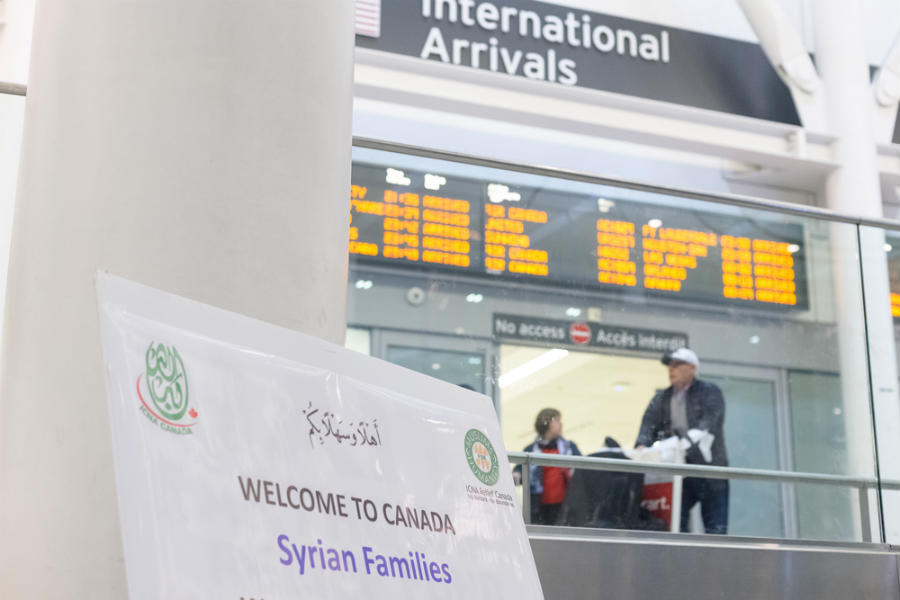
Syrian refugees in Canada
 © SHUTTERSTOCK
When the global total reached 1 billion, just 3%—30 million people—lived in cities. Today, the world is 50% urbanized; 3.5 billion people live in cities.
Urbanization per se is by no means bad, but it provides a different set of issues with regard to conflict. The prospect of “shadow” economies, the connections between the violence driven by politics with the relentless drive for money, and the status that comes through criminal gang violence all leading to conflict poses areas for concern. With weak state institutions, the violence becomes cyclical and relentless as criminal violence is traditionally met with the violence of law enforcement. Violence on violence.
It is hard to manage stressful change without adequate institutions and systems for doing so, which are lacking or deficient in many countries. Deficiencies in resilience are to be found at every level. Local, national and international arrangements and institutions that may have functioned reasonably well to date now face challenges they were not designed and equipped for. Furthermore, this is happening against the background of political change and instability in countries globally.
Understanding how the different elements of risk interact with each other is fundamental to conflict analysis, and to understanding what can be done to build peace in any particular context. The capacity to respond to challenges is necessary, but relying on crisis response is inadequate.
It is essential to meet emerging problems upstream—such that people can pursue conflicts without violence and harm to themselves or others. Thus, peaceful societies are when people can live in safety, have fair and effective laws, participate in shaping political decisions, make a decent living, and secure their well-being.
In order for this to happen, there needs to be strong advocates for creative dialogue, and diplomacy that understands the context and addresses civic empowerment. These should ultimately lead to the view that conflicts can and should be resolved peacefully as much as is humanly possible. And where and when that proves impossible, every effort must be devoted to returning to a situation in which violence does not threaten every person’s safety and well-being, and in which conflicts can be handled by dialogue, discussion, the law and settlement.
Dealing with conflict and building peace is about the long-term. While political leaders’ decisions are required to make these unfold positively, change does not come about at the flick of a switch. Similarly, while peace is most likely and strongest when many individuals gear their actions toward peacebuilding, the effects of activism are not necessarily quick or linear. Rather, change is indirect, incremental and cumulatively transformative.
This originally appeared on Fair Observer

Saturday, December 26, 2015

How can we prevent the suffering of millions? Fund local NGOs directly

Last week, the UN launched the biggest aid appeal on record. The amount requested by the Office for the Coordination of Humanitarian Affairs (OCHA) – $20.1bn (£13bn) – is five times the amount requested just a decade ago.
Faced with escalating conflicts and disasters and a growing number of affected people, we need to ask whether current approaches to aid and development are really the most effective ways to prevent the suffering of millions of people.
The data suggests not. The number of people in need of aid has more than doubled in just over a decade, according to OCHA.
So where is the money going? Not, unfortunately, into the hands of those on the frontline. Despite existing among the poorest and most vulnerable populations, and with a unique understanding of the communities they serve, local and national NGOs received just 1.6% of total NGO funding between 2010 and 2014.
And it’s not just the amount of funding that’s shrinking; the number of organisations sharing the money is also declining. At the same time, the UN’s share of humanitarian assistance continues to grow, along with that of international NGOs – just 10 INGOs received 36% of all NGO funding last year.

Investing in prevention

Local and national NGOs have long been thought of as indispensable to quick, effective and relevant emergency response, as well as critical development work. But the localisation of aid is still resisted, at a time when local and national NGOs must address humanitarian needs within increasingly complex and protracted crises.
What’s more, when emergencies have subsided and INGOs have left, local and national organisations stay behind, helping communities and governments to rebuild lives. This is essential to developing resilience to future crises. They can apply local knowledge to solving problems, and can access populations in areas that remain beyond the reach of international agencies.
Perhaps even more importantly, the worst impacts of many crises – especially those that destroy livelihoods and wreak devastation through famine and malnutrition – could be prevented or even avoided if local and national NGOs were better equipped.
This is why donors must fund local and national NGOs directly. The current funding landscape is so mired in appraisals, assessments, projections, and estimations that local aid workers cannot navigate its complexities, or afford fundraising and grant management staff to do so.

A new funding model

The most practical way to overcome these funding obstacles is to set up a transparent and well-managed pooled fund specifically for local and national NGOs. Such a fund would put money and power into the hands of those who are often excluded from decision-making and denied the opportunity to influence and advise on how money can be better spent. This funding would also help local and national NGOs build leadership capacity and give them some room to experiment, grow and learn – opportunities INGOs had at their beginnings.
By empowering these organisations to better address man-made and natural threats early, and funding them to build local resilience, we can reduce the need to mobilise massive and costly emergency response later.
The World Humanitarian Summit in May 2016 may be the most timely opportunity to make an honest appraisal of the effectiveness of the current system to deal with the sector’s “new normal” of finite resources and unlimited challenges.
Let’s not waste that opportunity. We can put people back at the center of aid and instill a sense of humility and service that is in danger of being lost to self-interest. Local or international actors alone cannot hope to stem the tide of misery blighting more than 125 million people around the world. But by working in a fair and equitable partnership, we can hope to limit future suffering and provide shelter, sustenance and hope to those who will not be so lucky.
This originally appeared here