Wednesday, March 22, 2023

In Memoriam — Dr M A Mohamed Saleem


Dr M A Mohamed Saleem

On the 20th of February 2023, my beloved father passed away after 4 days of being in the ICU following a sudden stroke. The nightmare that I had feared came to pass. I am not sure what is worse, dealing with a sudden death of a loved one or dealing with the inevitable death of someone who has been ill. Nevertheless, I have gone through many emotions grieving the loss of my father. From feeling overwhelmed, to intense emotions, to feeling like my childhood has suddenly disappeared, to feeling that I have to suddenly grow up. One month on, those emotions are still raw. All of this is normal I have been told, but it certainly isn’t easy, no matter what age you are to lose a parent and especially a father who has had a strong presence in your life.

My father was a man of deep faith and convictions and principles. He never compromised on this. Practically if you told him that you would call him or send him an email by a certain time, he would expect it. This was always a challenge growing up, when as a kid you learnt never to over promise and under deliver. But he made you value the concept of keeping your word and ensuring you helped people keep theirs.

Shortly after getting his PhD

He once wrote that “If you have to win the respect of people and live peacefully in this world, never consider yourself different from the rest and never expect special treatment from anyone”. This was how he lived his life not expecting any special treatment and not considering himself any different to anyone else. He went to great pains not to be an inconvenience to anyone, nor did he consider himself better than anyone because of his achievements. I never knew until recently about his ground breaking work in Nigeria or Ethiopia or the fact that he was one of the first PhD holders from the Eastern Province in Sri Lanka. He never chose to dwell on these accolades not because he didn’t value it, but because he feared that there would emerge an arrogance warranting special treatment because of it. He was very careful about arrogance and ego eating into the good deeds of someone. Many misunderstood this humility in him that meant that he didn’t show off his achievements and was always happy to not be in the limelight preferring to shine the light on others. At a time when people vacuously elucidate more than they have actually achieved, it was strange to many that my dad didn’t cave into societal demands or sang his own praises or that of his family. “Who are we trying to impress?” would always be his response when I would clash many times with him on this because the narcissist in me thought I had to talk about my achievements. His quiet diplomacy taught me a great leadership principle that when you shine the light on someone else, inevitable some of that light falls back on you.

My dad was simple, again a quality that was largely misunderstood. In a world of bigger, better and shinier brands, he was an island in continuing to simply advocate that success is not about the bank balance or the car you drive but the brain talent you possess and the value you bring to people around you. He would tell me “why do you need to drive a $200,000 car or wear a $1000 wristwatch when you can drive a $10,000 car or wear a $50 wristwatch? They both have a functionality and a purpose. It’s not making you more efficient to have the more expensive product. You can save that and use that to help someone”. He lived that mantra as he truly believed that if you can make a difference in someone’s life, then you are a rich person. Judging from the number of people who have contacted our family following his passing saying how he helped them, my father was indeed a very wealthy man, touching the lives of all those he met with a compassion that I have not seen and having countless of voiceless people praying for him and sending him their thanks. From security guards from neighbouring houses, to trishaw drivers to academics, political leaders, faith leaders, leaders of industry, all came to pay tribute to him saying how he had helped them or advised them or touched their lives. There is a concept within Islam of giving in charity with your right hand so that your left hand doesn’t know. Certainly, dad gave in charity that we did not know about. Even recently we have been getting messages from different parts of the country of the level of his generosity. There are at least 3 or 4 Dr Saleems in Nigeria, kids who were named after my father, after their fathers worked for our family and the gratitude that they had for him and the greatest honour they could bestow in naming their kids after him. Someone in their condolence message to me said he dined with kings and walked with the poorest of the poor and there was no difference in how he treated them. This is the best description someone can give about my father.

He was a self confessed “Ghandian”, espousing subsidiarity, power from the bottom up as key to bringing about societal change. He truly believed that you had to model that change you asked people to aspire towards, and you could see him modelling this through his behaviour, diet and his relationships with others. He would tell me “Don’t ask people to sacrifice or volunteer something if you are not prepared to sacrifice it or volunteer yourself”, and sacrifice he did, whether it was his time or his money for a cause greater than himself.

He was also a quiet man, with very few words, but always reflecting and thinking, and asking the right question at the right time. He mastered the art of asking the right question and I have seen people who are experts flummoxed by his curve ball questions asking them to think about something they had not thought about. I remember him asking someone from Transparency International how transparent they were, when they came to pitch to a charity he was involved in about their services.

One of his philosophies in life was that he never wanted to be a burden on anyone or to cause inconvenience. Conflict was not his style, preferring to not engage or being a true preponderant of the Third Alternative, seeking creative solutions to problems. “Everything has a solution that could be overcome”- It’s something that I truly try to model in my own life, not to think within the box but to think there is no box.

Standing at the Peace Village in the East of Sri Lanka in 2014

He chose the mantra that “I will speak only when I have something useful to contribute”. Yet his quietness had a strength of character and purpose which is evident by the glaring hole and silence we feel in our lives and the home in Colombo, such was the strength of his character.

Next to being a deeply spiritual person, his second religion (as one of his school friends told me) was love. The love and compassion of people, friends, and of family. He was proud of his roots and his influences both in Sri Lanka, UK, Nigeria, Ethiopia. He was proud of his Commonwealth Scholarship that enabled him to do his PhD at the University of Ibadan, where he formed close ties with his supervisor from India. Even today, the ties with that supevisor’s (who has sadly passed) family are strong. He was proud of being an old boy of Jaffna College, understanding cultural diversity and inclusion in a way that was not understood then but has now become an industry within the international development sector. For him diversity was a positive disruption bringing different ideas and perspectives to the table. That pride and experience he carried with him even to his death and evident from all those who came to mourn him. Even a week before he passed away he had participated in an old boys association meeting. Conspicuous by their presence at his funeral and the days and month that has passed has been his classmates from over 50 years ago, who still remember “Saleem” as he was known, for his mischief, but more importantly for his appreciation of the other and respect for human dignity. Despite being spread across time and space, these relationships and memories are testimony to someone who truly understood and embraced diversity.

Addressing the Jaffna College Old Boys Association Meeting in February 2023 (courtesy of Jaffna College OBA Colombo Branch)

He was a proud Sri Lankan always discussing the potential of what the country could be, blessed in its diversity and open to the concept that the country belongs to all, he pushed for greater equity and equality at all levels of society and would write about it endlessly in a number of different columns. He emphasised that all of us have a role to play to contribute because the country belonged to all of us, not to a certain race or faith. This was what he had learnt from school and his friends and time abroad and is something that he truly felt Sri Lanka as a melting pot of faith and culture could aspire to. Even to his final days, he was thinking and writing about how we can work on improving Sri Lanka. One of his conversations with me was lamenting about how sad he was about the number of people wanting to leave Sri Lanka for pastures new. He wasn’t against people leaving the country but he also felt that after having spent more thatn 32 years abroad, there was no place like home, and that it was only Sri Lanka’s loss that bright people were leaving.

Addressing the Swarajya foundation conference in 2005

For him the concept of family and home was perhaps the third religion. Having been sent to boarding school at the age of 8, he was always keen not to lose out on the notion of the family. It was a conviction that centred him throughout his life and something that I grew up strongly believing in. When I was younger, after having watched the Godfather movies, I used to joke with him saying that our family seemed to be like the mafia because family was everything. However it was something that he strongly believed in. A year after he got married, my maternal grandfather passed away from cancer leaving a very young family to care for. My father took it upon himself to become the second father of my mother’s family. In later life, he would become a fatherly figure to the families of his siblings. My father would later tell me that this experience disciplined him and made him realise the importance of responsibility. It is this sense of responsibility for family that made him take early retirement in 2001 and move back to Sri Lanka allowing my mother to come back and spend time with her mother. When the tsunami struck Sri Lanka in 2004 affecting our immediate family, it is that sense of responsibility that allowed him to take a lead in the role of the recovery process for the larger extended family, ensuring the sub family units to return to their homes once the water levels receded. The post tsunami period from housing to coordinating support and recovery were done in the spirit of preserving family cohesion and common interest. My father when he retired in 2001, said that he wanted to spend more time looking after my mother, which in the last 6 months of his life, he did when my mother fractured her arm and needed support. The pleasure he took to look after her was evident in how he spoke of being blessed by God to be able to look after mum in a way she had done for him for the last 53 years. He was discovering the joys of being a grandfather to 4 grandkids and interacting in a way perhaps that he had not done previously with my sister and I. I would joke that he was having to do the things with his grandkids that he didn’t have time to do with his kids. He simply enjoyed this new role and talked about how blessed he was to have that new responsibility. Family was extremely important for my father. When I was getting married, he would tell me that it is not just an extra person coming into our family but her entire family as well. Family bonds were essential and sacrosant to him and it pained him when there were strains and tensions. In his true way though where there was conflict, he never wanted to take sides but would try and mediate. He would not know it but in his death, his dream of a united extended family has come true with family from his side, my mom’s side and my in-laws coming together, pitching in and working together. It’s one of the times that I miss that I can not share that anecdote with him, knowing how happy he would be to see people working together. More than anything he was always so proud to see the next generation standing up and developing their own lives. In death, I learned what my father had always tried to teach me about the importance of that extended network of family, who rally round and often sacrifice themselves to support you at times of great need.

He would teach me that taking responsibility is important in whatever needs to be done, and understanding your ability to respond to a situation. This is definitely one of the key lessons that I have taken in my life in whatever I do. This meant doing what you could do and being the best about it.

My dad was a deeply practicing Muslim, proud of his faith. My enduring memory of him is always murmuring some prayers whenever he could. He never missed his compulsory and supplementary prayers and fasts, nor the recitation of the Quran. Unwavering on compromising his faith, he also sought to delve deep into the meaning of faith. He was not content just to blindly follow but to question, to seek, to dig deep and understand. I understand and inherited his love of reading, digging into the theology, spirituality, understanding different Islamic movements, politics and intricacy of the Islamic faith. Spiritual practice was something he really sought to inculcate in his life and something he shared with me. The importance of that discipline of doing small practices regularly every day and not focussing on trying to do big things, but also the sense that anything that you do can be turned into a sense of worship. I would often complain about the mundane and regular things in life and he would respond “these are just opportunities to show your gratitude to the Almighty and also an opportunity to correct yourself on a regular basis”; so that regular commute turned into a journey of reflection and pondering and asking “Is there something I can do today that I didn’t do yesterday? Is there something I can do to make today better than yesterday to correct any mistake that I made?”

He was someone who cared deeply about the ethics and behaviour of Muslims beyond just adherence to articles of faith. For him, adherence to worship had to give Muslims an edge in terms of their behaviour with each other, their character and the values. If this was not the case, then mere observance of prayer or fasting would not suffice. He was often distressed with the state of the global Muslim community and in particular the state of affairs of the Sri Lankan Muslim community. He would not hesitate to tell off academics, religious leaders or politicians if he thought they did something wrong. He would talk for hours about how he felt that Muslims had departed from their spiritual purposes and focussed more on form not spirit. He would say that there are a lot of Muslims nowadays but there is very little Islam, very little development in the internal spirit of Muslims who he felt focussed more on outward manifestations of piety. His analysis was based on the fact that the behaviour, attitudes and values displayed by Muslims were often at odds with the teachings, practices of Islam whilst he felt they focussed more on dress code and food. His thinking around Islam and Muslims often put him at odds with the mainstream Muslim intelligentsia, but endeared him to many others. He was credited by a Buddhist monk for helping said monk change his negative perceptions of Muslims. His approach to understanding Islam and its purpose in the world is the foundation of how I approach my interpretation of the faith, the teachings and the practices.

At an inter religious conference in 2016

He also laid great emphasis on interfaith dialogue and the role of faith leaders. He saw the latter not just as teachers of prayer but more as instruments of ethics and values. His vision was that religious leaders should have a greater role to play to combat and denounce racism, discrimination and any threats to human dignity. He called faith leaders the conscience of society and called on them to rise to the challenge of valuing human dignity. In recent years, he focused on spirituality as transcending religion and rising above ideological affiliations, being the glue that binds people together in a spirit of ethics, morals and basic humanity. He understood the need for a common space and substance from which can emerge a shared vision to trigger action for the unity of humanity underpinned by compassion. Idealistic yes, but totally aspirational, which has prompted a Christian priest to say that “Dr Saleem was not a religious leader but a leader of religions”

My dad and I (i was aged 2 or 3)

My experience with my father I can surmise, was in three phases. The first phase was as a son who enjoyed life with his father. Between our time in Nigeria and Ethiopia, I have fond memories of a fun loving father who loved horse riding playing tennis, organising birthday parties and going on holidays.

My father in Nigeria (courtesy of Mark Powell)
with the farmers in Nigeria (courtesy of Mark Powell)

I rarely knew of his professional background but I knew he travelled around a lot because of work but it meant more toys for me. I never knew of his work but in recent years have come to realise his intellectual impact especially when Academia.Edu tags me on papers that reference his work and writings still to date and asks me if I that “Dr M A Mohamed Saleem”? Someone called him the “father of the fodder banks” but in true reflection to my dad’s character he underplayed this achievement. Yet his ties with his ex colleagues from Nigeria and Ethiopia are as strong now as they were then and have transcended generations with myself working and engaging with a number of them.

Enjoying the coast of the UK in 1997

The second phase was when I went to boarding school and then university back in the UK at the age of 16. I know my father was reluctant to send me based on his experiences at boarding school, but made it a point to try and visit every quarter as he transited in London on every official trips that he made. it meant that my friends and i got treated for fancy dinners which when you are a struggling uni student meant quite a bit. During this time, it was a learning time for me, understanding how to see the world and to take decisions on what to do or not do. I may not have fully followed through in my learnings, but this time of spending together allowed me to focus on my career as an engineer and then to diversify. I still value that time that he took to come and spend even a day with me during his official trips. More importantly I valued the supply of food that he would bring from my mother.

Working together in 2005

The third phase was after the tsunami in 2004, when I came back to work with Muslim Aid in Sri Lanka’s post tsunami recovery and I had the privilege of working with my father on different projects.At that time, my father had developed a keen interest in understanding the ghandian philosophy and working on alternative energy and medicine, along side his interfaith work. This was the synergy that allowed us to come together to work on something better. Though we sometimes had professional differences on how to approach things, we always resolved it in a way to learn from each other. It remains my greatest pleasure and honour to have worked alongside him on a number of different projects along the years from the Commonwealth People’s Forum to a number of peace conferences to humanitarian relief to engaging with faith leaders. I would also have a stint at working with him again when I came back to work in Sri Lanka from 2013–2017 and though it was a different platform, the aim was the same. How can we best unearth the potential of Sri Lanka? more improtantly what was the role of faith leaders and faith communities? The time that we worked together was the most valuable university lesson that I have followed. it is these lessons that I carry with me when I deal with people or situations.

Meeting with government officials in 2014

He was not only my father but my mentor and professional confidante. When I had issues at work I would talk to him about the frustrations of not being valued, and he would always remind me that the value is in the work being done and the impact being felt on the ground and being seen in the eyes of God. “Don’t worry about these temporary accolades and appreciation so long as He knows what you are doing” was his constant reminder as he sought to temper my urge for more. Accolades only serve to make you forget who you are was his response.

One of my last conversations with him was around legacy and my worry about what mine would be. His answer was typically that “those whose legacies posterity talk about and idolize never, in their lifetime, were concerned about their own legacies. They lived a life of conviction and realization that they had a purpose and pursued it regardless of their own challenges and changing circumstances. Only when such people depart from the stage others who had been around or who came after them built up legacies for the departed. Those who were deeply concerned and conscious about their legacies invariably were also found to live double lives and exhibited split personalities. This is because such people tended to tailor their actions to cater a targeted and selected group(s). We can see this happening more in this contemporary world. Such legacies have no value either to the one who worked hard to accumulate them or to those who succeeded that person as siblings, or associates. after the person’s departure. Such legacies may not even have any value and may even be discounted in the final assessment. One requires no fancy education or material resources to build this legacy. It requires only the realization that every human is to function as a humble servant and he is required to be the vicegerent of the owner for the beginning and the end. It does not matter what means of livelihood the person adopts.”

He was my editor for numerous pieces of my academic writings and especially during my PhD phase, read through my thesis at least twice to ensure that it made sense. In fact, the last piece of work that he helped to edit was a chapter I wrote around Muslim Democrats in Sri Lanka for the book ‘Rethinking Islamism beyond Jihadi violence’. In his typical thoughtful way, he cautioned me to reconsider whether people might misinterpret what I was trying to say and asked me to reframe the points being made. “We can’t conflate islamism with jihadi violence but its also important you stress the true nature of Islam” is what he told me.

Sharing my PhD with the original Dr M A Mohamed Saleem

When I got my PhD in 2019, I joked with him, we now have a Dr M A Mohamed Saleem, number 2, to which he replied “I have to retire now”. But typically that was my dad, his next response was, “what are you going to do about it now?” His philosophy was that you just do the best you can in what you can do. Be the best. If you are a street cleaner, be the best. If you are the scientist be the best. Never rest on your laurels, continue to work and push the boundaries.

Little did I realise that 4 years after, this retirement would be permanent and suddenly that anchor and compass would no longer be there. In his book “Who will cry when you die?”, Robin Sharma talks about tapping into that special ability to make the world a better place. My father had this special ability to connect with someone, make them feel important, special and unique, to understand their problem and come up with a way of helping them. The 11th century persian scholar Abu Sa’id Abul-Khair said (and this was taken up by Ralph Waldo Emerson amongst others) that “When you were born you were crying and everyone else was smiling. Live your life so at the end, you are the one who is smiling and everyone else is crying.”

My dad would certainly have been embarrassed at all the accolades that are being thrown his way, in the wake of his passing and by all the people who have emerged from the woodworks to pay him tribute. He would probably be angry with me for writing this because he was one to stay in the shadows. I hope that he is smiling because his life was full and that his legacy is a continuous charity which all of us will strive to emulate and keep going and that he forgives me for wanting to share his story and example with the world as a way to inspire, to remember and to celebrate him.

Whilst my father in his quiet way achieved a lot for the community, he was first and foremost my father, and I will truly miss him.

May God bless him, and accept him into His highest fold. May we be united in a better abode.


originally published here on medium

Saturday, November 19, 2022

The role of sports and education in building durable, just and sustainable peace – the lessons from COVID


In this blog post, part of the NORRAG Blog Series on the Role of Quality Education in Building Just and Sustainable PeaceAmjad Mohamed-Saleem, Protection, Inclusion and Engagement Manager at the International Federation of the Red Cross and Red Crescent Societies (IFRC), discusses the positive impact sport and life skills have on young people, specifically as a way to counteract the effects of the COVID-19 pandemic, which has led to the social isolation for that group. Mohamed-Saleem refers to results from youth empowerment projects led by IFRC in partnership with Generation Amazing – Qatar 2022’s Supreme Committee for Delivery & Legacy.

15% of the world’s population – some 1.2 billion people and counting – are aged between 15 to 29. The COVID lockdown has disproportionately affected people’s lives, especially millions of young people worldwide, with public health restrictions and socio-economic disruptions having a devastating impact on their education, mental health, career prospects, safety, and personal development.

Initially, children, adolescents and young adults were considered less vulnerable to the virus, but developments during the pandemic have shown otherwise. A World Vision investigation, revealed three key factors that COVID-19 has changed in the lives of children and young people on a massive scale: school disruption, emotional distress due to social distancing and increasing poverty (World Vision International, 2020). The research highlighted isolation and loneliness of young people because of school closures, on top of the disruption of their learning and daily routines. In addition, there is an acknowledgement of emotional distress and troubling feelings, linked to the uncertainty about how long the crisis and imposed isolation would last and the disruptions already caused to education, livelihoods, development, safety and mental health.  The pandemic has also exacerbated the mental well-being of young people (WEF, 2021) leading to greater aspects of depression, illness, disability and suicide.  To counter the repercussions on mental health in youth, reports (WEF 2021) suggests lifting the measures that have led to the social isolation of young people and makes a case for sleep and exercise which are effective in boosting mental health. Given the longstanding recommendations from medical professionals about sleep and physical exercise, it is pertinent that sports for development and peace projects can provide good examples to authorities and policy makers especially in the education and health sectors, to ensure that children, adolescents and young adults are taught techniques and approaches on life skills and enjoy a physical activity (whilst providing opportunities to do some social enterprises and community work) to help them sleep better and also have a better balance of mental health and social engagement.  In addressing mental health issues of young people, it must be realized that this is a whole of society issue rather than just a youth issue.

Whilst there have been some critical lessons taught by the COVID-19 crisis, the importance of transformation and innovation have been made possible.  The concept of remote and hybrid education, which became a necessity when the pandemic hit, provides the potential to transform the future of learning if systems are strengthened and technology is better leveraged to complement skilled and well-supported teachers.

In addressing the current challenges to do with youth isolation, exclusion, and violence prevention, the International Federation of Red Cross and Red Crescent Societies (IFRC) has spearheaded a new project in partnership with The Supreme Committee for Delivery & Legacy of Qatar 2022 (SC) – Generation Amazing (GA).  The project is a unique hybrid of football for development skills (F4D) and Youth as Agents of Behavioural Change (YABC) and complemented through community micro projects. F4D is GA’s flagship programme that empowers and educates future generations around the globe to address three priority issues: vulnerability, health and wellbeing, and environmental sustainability. YABC is the IFRC’s flagship humanitarian education[1] initiative on the promotion of a culture of non-violence and peace (CNV+P), that empowers young people to take up an ethical leadership role in inspiring a positive transformation of mindsets, attitudes, and behaviors, both within themselves and their communities. It is built on three pillars: empowerment, operating from inner peace, and reaching out to the community.

The new project YABC/F4D project, “Uniting through the power of football’ consists of a hybrid curriculum that has been developed to combine the (Y)ABC methodology and  F4D approaches to use football as a driver for social changedeveloping youth leadership and inculcating a social entrepreneurship spirit through micro projects.  The project is intended to mobilize vulnerable at-risk young people and communities in out-of-school activities to help prevent the occurrence of violence, improve their access to education and employment, ensure better social inclusion and build resilience in excluded at-risk communities, leading to healthy lifestyles, greater engagement, fewer problems with peers, and increased pro-social behaviour. Through the project, young people will not only experience personal transformation but create an external ripple of change through community work whilst playing and learning about football. As they navigate their leadership journey, they will learn powerful skills around discipline, healthy living, teamwork, and engage with their local networks in meaningful ways. By doing so, they will create change in their schools, neighbourhoods, and the broader world by implementing solutions to some of the most challenging problems of our time from a community-based lens and with the initiator of this being the F4D methodology combined with YABC approach and additional basic educational processes. The project will involve thousands of young people in this process and will in turn create thousands of solutions directly implemented by young people.

The project is currently being trialed with Red Cross Red Crescent National Societies in Argentina, Uganda, Myanmar, and Iraq testing outcomes identified in the multi-country project design to assess the effectiveness and impact of combining the IFRC’s (Youth as) Agents of Behavioural Change ((Y)ABC) and GA’s Football for Development (F4D) initiatives.  With the onset of COVID lockdowns, much of the hybrid curriculum has had to be adopted for the online space with IFRC YABC trainers.  As the project unfolds, it expects to have an impact on the improvement in the social inclusion of marginalized and excluded youth, particularly those living in at-risk communities, refugees, and internally displaced young people, as well as in host communities, by recruiting disadvantaged youth to participate in football driven leadership development programmes. The programme puts forward a community-based model of resilience using team sports to address issues of identity, belonging and cultural isolation whilst also encouraging locally sourced ideas to address community problems which are then supported through small community micro projects.   It aims to prove that with the provision of life and leadership development skills, as well as learning opportunities to vulnerable and excluded community-based young people through an integrated F4D and (Y)ABC skills training programme, the of enhancement of local capabilities coupled with an opportunity to solve real community issues, will help young people drive social change on the ground and take responsibility for those actions. This will ultimately lead to an enhanced well-being and personal resilience of vulnerable youth.

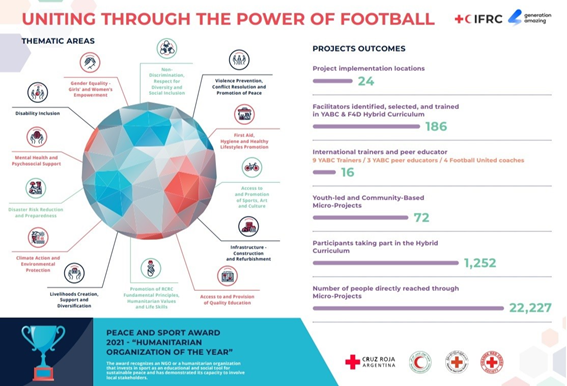
So far the results speak for themselves (see the figure below). In 24 locations in 4 countries, 186 facilitators have been trained in delivering the hybrid curriculum. 1252 participants have taken part in the Hybrid curriculum developing 72 youth led and community based micro projects reaching around 22,300 people.  All of this within the space of a year under COVID restrictions and in the case of Myanmar, uncertainty caused by political instability.

One of the facilitators from Myanmar has described this project as “light in the midst of darkness”, whilst another participant from Uganda, a refugee who had fled conflict, expressed his feeling that “with this project, I have the chance of expressing my talent and being useful to the community once again”.  What has been also unique about the project is not just the change in those attending the programmes but also for the community who have also benefitted from the trainings and micro projects.  As a mother from one of the branches in Argentina stated, “the pitch has become a safe space for everyone to come and mix and overcome division.  By also participating with our children in these workshops, this has changed how we interact as parents”. The National Societies themselves have also noticed that change as this statement from the Iraqi Red Crescent testifies “The National Society was able to detect a significant change in the attitudes and behaviours of participants and the success of the project in fostering the ‘spirit of cooperation among all and the sense of belonging to the society”.

IFRC and GA believe that young people represent the single greatest untapped resource for good across the globe. They are ready to change the world. Through this project both partners want to show that sport and life skills will equip this generation of young people with the necessary skills and mindset to change the world for the better –not someday in the future –right now. They are hungry to lead and imagine innovative approaches to make their communities healthier, safer, and more inclusive, while writing new narratives of who they are and what they are capable of.

Amjad Mohamed-Saleem, is the Protection, Inclusion and Engagement Manager at the International Federation of the Red Cross and Red Crescent Societies.

[1] Humanitarian education (HE): education that enables individuals – especially children, adolescents and young adults – to interpret situations from a humanitarian perspective and develop the knowledge, values and skills that empower them to take action in the spirit of the Fundamental Principles, helping and caring for themselves and others, and thereby contributing to building resilience, social inclusion and lasting peace in their family, community and society.


this originally appeared here

Wednesday, October 26, 2022

Be Human

A few weeks ago , I was invited to give the closing keynote at the GoodFestival, organized as part of the graduation of the Roxbourg Humanitarian MBA sessions. I have also been privileged to be part of the Humanitarian MBS process since its beginnings last year.


Giving the closing keynote, I have been humbled by the journey that many who have gone through this process to make their social ventures possible. So I have been inspired to focus less on social ventures and more on the people behind the ventures because this is where the real magic is.


— —


Thank you Rajiv for the invite. It is an honour for me to be here this evening. It is also truly humbling.


I am humbled just to listen to the ventures generated by your ideas that you have generated to make your communities, societies and ultimately the world a better place.


I am also truly humbled by your courage to take the next step to be social entrepreneurs during these difficult times. I want to acknowledge how incredible you all are for making it this far. This past year and a half has tested so many of us, and I can’t imagine having to muster up the enthusiasm, much less the strength and courage, to start while the world was falling apart around us.


Courage

As Nelson Mandela said, “I learned that courage was not the absence of fear but the triumph over it. the brave man is not he who doesn’t feel afraid but he who conquers that fear”.


Congratulations for conquering that fear!


I promise you that, despite the insanity and uncertainty you’ve endured, you will cherish these years and the people around you who have been part of the journey either as part of Roxbourg or those who have supported you, for the rest of your life.


So today is a day of celebration. A day to celebrate all the hard work that got you to this moment.


Today is a day of thanks. A day to thank those who helped you get here — nurtured you, taught you, cheered you on, and dried your tears.


Today is also a day of reflection. Because today marks the end of one era of your life and the beginning of something new. Something new in terms of the next journey of the life of your social venture. So as you start this new journey, I want you to close your eyes and think of a blank canvas. With that canvas, what picture would you paint, what colours would you use, what would you be expressing? The picture you paint is one of the future of where you see yourself. Hopefully as you paint this picture, you will also picture why you wanted to start this venture or not. It might answer the questions of what prompted you to come here and what prompted you to continue to be part of Roxbourg. It is these feelings that should inspire you.


I want you to remember these feelings as you continue your journey of personal development and seeking to make the world a better place.


This journey with Roxbourg should have 1) granted you the room to make a space for yourself if you didn’t see one, which in turn, gave you the confidence to create a space for yourself; and most importantly and life-changing is 2) the community it has allowed you to build and allowed you to overcome the challenges.


Challenges

So I want to talk about challenges and overcoming them.


There will be challenges and this will mean that you have to learn to steer your ship into the choppy seas not away from them. This is the only way to learn and overcome. And as you steer your ship, look for the rough spots, the problems that seem too big, the complexities that other people are content to work around. It’s in those places that you will fulfil your purpose. It’s there that you can make your greatest contribution and building something better.


In a world where we obsessively document our own lives, most of us don’t pay nearly enough attention to what we owe one another and how we connect to each other. So part of this journey is about recognizing that human civilization began when we realize that we can do more together: that the threats and danger outside the flickering firelight get smaller when we get bigger. We can create more — more prosperity, more beauty, more wisdom, and a better life — when we acknowledge certain shared truths, a shared humanity and we act collectively.


We need to remember that not a single one of us here today has done or can do it it alone. We are each a mosaic of those who have loved us, those who have believed in our futures, those who showed us empathy and kindness or told us the truth even when it wasn’t easy to hear, those who told us we could do it when there was absolutely no proof of that.


Remember that someone read stories to you and taught you to dream and offered up some moral code of right and wrong for you to try and live by. So you need to pay this forward.


Kindness

No matter how cliché it may sound you will never truly be successful until you learn to give beyond yourself. Empathy and kindness are thus the true signs of emotional intelligence.


You want your work to be meaningful? Then be kind. Your life has to be a gradual process of becoming kinder and more loving and that’s when meaning brings the real richness to your life. What you really want is to be surrounded by people you trust and treasure and by people who cherish you. That’s when you’re really rich.


Hurry up. Speed it along. Start right now


Failings

Now I want to talk a little bit about failings, Because nobody’s journey is seamless or smooth. Innovation is about failing and learning and relearning. We all face complexity and uncertainty no matter where our path takes us. That means we all face the risk of failure. So along the way, we all are forced to develop these critical capacities — of judgment, teamwork, and acceptance of responsibility


As a social entrepreneur, you will stumble. You will have setbacks. However remember, that if things go wrong, you hit a dead end — as you will — it’s just life’s way of saying time to change course.


So, ask of every failure, every crisis, every difficult time: “what is this here to teach me?”


And as soon as you get the lesson, you get to move on. If you really get the lesson, you pass and you don’t have to repeat the class. If you don’t get the lesson, it shows up wearing another pair of clothes — to give you some remedial work.


I can assure you that difficulties come when you don’t pay attention to life’s whisper, because life always whispers to you first. And if you ignore the whisper, sooner or later you’ll get a scream. Whatever you resist persists. But, if you ask the right question — not why is this happening, but what is this here to teach me? — it puts you in the place and space to get the lesson you need.


Eckhart Tolle, who’s written this wonderful book called A New Earth reminds us about letting the awareness of who you are stimulate everything that you do. He puts it like this: “don’t react against a bad situation; merge with that situation instead. And the solution will arise from the challenge. Because surrendering yourself doesn’t mean giving up; it means acting with responsibility, you have to be in the moment. Whatever has happened to you in your past has no power over this present moment, because life is now. Don’t live for yourself alone”.


So in order to be truly happy, you must live for the now and you have to stand for something larger than yourself. Because life is a reciprocal exchange. To move forward you have to give back. And to me, that is the greatest lesson of life. To be happy, you have to give something back.


And when the challenges come, I hope you remember that anchored deep within you is the ability to learn and grow. You are not born with a fixed amount of resilience. Like a muscle, you can build it up, draw on it when you need it. In that process you will figure out who you really are — and you just might become the very best version of yourself.


So, it’s a lesson that applies to all of our lives as a whole. What matters most is what’s inside. What matters most is the sense of integrity, of quality and beauty.


You will be defined not just by what you achieve, but by how you survive. So build resilience in yourselves. When tragedy or disappointment strike, know that you have the ability to get through absolutely anything.


The journey

As I have repeatedly said, this is a journey.


Enjoy the process of this journey without succumbing to the pressure of the result. Trust your gut, keep throwing darts at the dartboard. Don’t listen to the critics and you will figure it out


I just want you to know you will never be alone on whatever path you may choose. If you do have a moment where you feel a little down just think of the support you have from this great family


Build and tap into your community. The brilliant minds who have accompanied you in this journey will have a hand in shaping the culture, making this world better, leaving long-lasting legacies behind and doing a bunch of other important things.


So continue to build resilient communities.We find our humanity — our will to live and our ability to love — in our connections to one another. Be there for your family and friends. And I mean in person. Not just in a message with a heart emoji. Remember that this is about being human and establishing that human connection.


The Guest House

I am reminded of the poem by the famous 13th century persian poet Rumi


This being human is a guest house.


Every morning a new arrival.


A joy, a depression, a meanness,


some momentary awareness comes


As an unexpected visitor.


Welcome and entertain them all!


Even if they’re a crowd of sorrows,


who violently sweep your house


empty of its furniture,


still treat each guest honorably.


He may be clearing you out


for some new delight.


The dark thought, the shame, the malice,


meet them at the door laughing and invite them in.


Be grateful for whoever comes,


because each has been sent


as a guide from beyond.


This being human is about recognizing the different emotions that come to us.


This being human is about accepting the differences and the needs. One of the greatest human hungers is the need we all have to make a difference in the lives of others. The purpose of life is a life of purpose; to be useful, to be responsible, to be compassionate, to seek justice. It is above all to matter, to count, to stand for something, to have made some difference that you have lived at all, to contribute to the saving of a life because to save one life is as if you have saved the whole of mankind. The highest and most enduring gift that you will give is the gift of what you leave behind. What makes greatness is something that does not end with you.


These are the universal values and principles that bind us in the brotherhood of humanity and help us to think of a world that makes sense where we connect to one another, where we are compassionate, working in partnership with our neighbours and friends working together towards that one single goal


So once again congratulations on getting to this start of the journey. Good luck. Enjoy the journey with your fellow travellers; have fun; share; learn and unlearn. I look forward to seeing the new ideas coming through


Remember that what ever you do the law of reciprocity will prevail. As the eastern philosophy states that a little bit of fragrance always clings to the hand that gives the rose.


Let me finish off with 10 b’s


BE INNOVATIVE


BE CREATIVE


BE OPEN


BE PRINCIPLED


BE TRUSTWORTHY


BE COMPASSIONATE


BE PATIENT


BE HUMBLE


BE FUN


And in the words of Rumi BE HUMAN


May you shine so brightly that at the end of your days, all will pause and say ‘ah there was one who lived life fully and completely and gave back ’


Thank you


--

Originally written here on Medium

Saturday, April 2, 2022

Ramadan — reinforcing our relationships

 For many Muslims worldwide, the 2nd of April marks the first day of Ramadan, the observance of the fasting (from food, water and innate desires) between sunrise and sunset. Muslims will faithfully observe this third fundamental pillar of Islam as has been ordained by God. In addition to the physical sacrifices and discipline that Ramadan brings about, it also represents a spiritual space for remembering and strengthening relationships: with yourself, with the Creator and with each other.

Relationship with the Creator

We are invited to re-examine our relationship with the Creator. Through acts of worship during the Blessed Month we take up a dialogue with The Most-High and The Most-Close, a dialogue of intimacy, of sincerity, of love. This re-examination allows us to realize that we marry the purpose of our existence with the purpose of our subsistence, whilst nurturing the inspiration from the Qur’an that ‘God will not change anything for the good if you change nothing’!

Ramadan reinforces within ourselves the importance of detail, precision and discipline in whatever task that we perform. Through Ramadan, God teaches us that in the quest for spirituality and meaning, rules will have to be respected, consistency maintained and time mastered. So as we debate on the precise starting and ending day of Ramadan; and we faithfully adhere to the precise time to stop eating and to break the fast; and we perform prayers at the specified times; so must we continue this discipline of precision and practice in all that we do.

Relationship with ourselves

Ramadan offers us a space to ponder, to reflect, to seek, to find and to learn in order for us to make crucial life changing decisions as we align ourselves towards the Centre and the Meaning and re-examine the relationship with ourselves. Seeking that meaning is best understood if you have read The Alchemist by Paulo Coelho, where the understanding is very simple: ‘Go; travel the world, look for the truth and the secret of life — every road will lead you to this sense of initiation: the secret is hidden in the place from which you set out’.

This is in essence the ultimate paradox of spiritual experience whereby the constant effort that we make to purify, to control and liberate our hearts is in the end, a reconciliation with the deepest level of our being and the All Spark that the Creator breathed into our heart, of humility, of compassion, the awareness of fragility, the consciousness of limitation, the shoulder of responsibility. The responsibility to live justly and fairly. It is a responsibility that connects to the ‘other’, the responsibility to be that change for a world which makes sense, a world in which we connect with other people, beyond our immediate communities and experience, where we show them compassion and love.

Relationship with the Other

At the heart of our consumer society, where materialism and individualism drive our daily lives, this love and compassion is vital as we are reminded of our unity and universality through a celebration of the faith of fraternal atmosphere shared with all brothers and sisters. We are reminded to ‘serve humanity especially those in need; to awaken our conscience in the proximity of the wounds and the injustices people face as we are taught that God’s favor lies with acts of kindness and humility to everyone around you. As narrated by the Prophet (Peace be upon him) of the story about the ‘thirsty dog which was on the brink of death, and of the passing prostitute who witnessed this, removed her shoe and used it to draw water from a well to give to the animal. For this small act, the woman was granted forgiveness for her lifetime’. The lesson that we learn from that story is that our purpose of existence is to stand by justice and equity; to portray the humility and compassion of the Prophet (upon whom be peace) towards the downtrodden, the distressed and the oppressed.

Ramadan invites us to re-examine our relationship with our society. It teaches us that we share the burdens of others (especially those less fortunate than us) and we remember our responsibilities towards them. Identifying with others in different ways is important in our role of living in society as founded upon a universal humanitarian principle based on the following verse from the Holy Qur’an “…If anyone saved a life, it would be as if he saved the life of all mankind…” (Q5:32).

Hence this is the purpose of our existence. Collectively and individually we have to recommit ourselves to realize a dream and fulfill a covenant that was made with the One: to stand by justice and equity; to show humility and compassion towards the vulnerable and marginalised, the downtrodden and distressed regardless of who they are, as we have been taught countless times before. Our covenant is to serve humanity; to be witnesses against the injustices that afflict them. Because humanity has the right to have witnesses living among them, willing to defend the truth; willing to serve them, no matter how unpopular it is. This takes determination and courage where courage is not the absence of fear but courage is to move despite your fear. This is the dream that we aspire to. This is the need of the hour.

Thus Ramadan is about reinforcing relationships though a reconnection with our spark, reinforcing our personal effort and commitment and inviting us towards the deep horizons of introspection and meaning reminding us of silence, restraint and remembrance.

So a world which makes sense, is a world in which we connect with other people, often beyond our immediate communities and experience, and show them compassion and love. This is the ultimate aspect of the relationship building as inculcated by Ramadan.

Published here on Medium